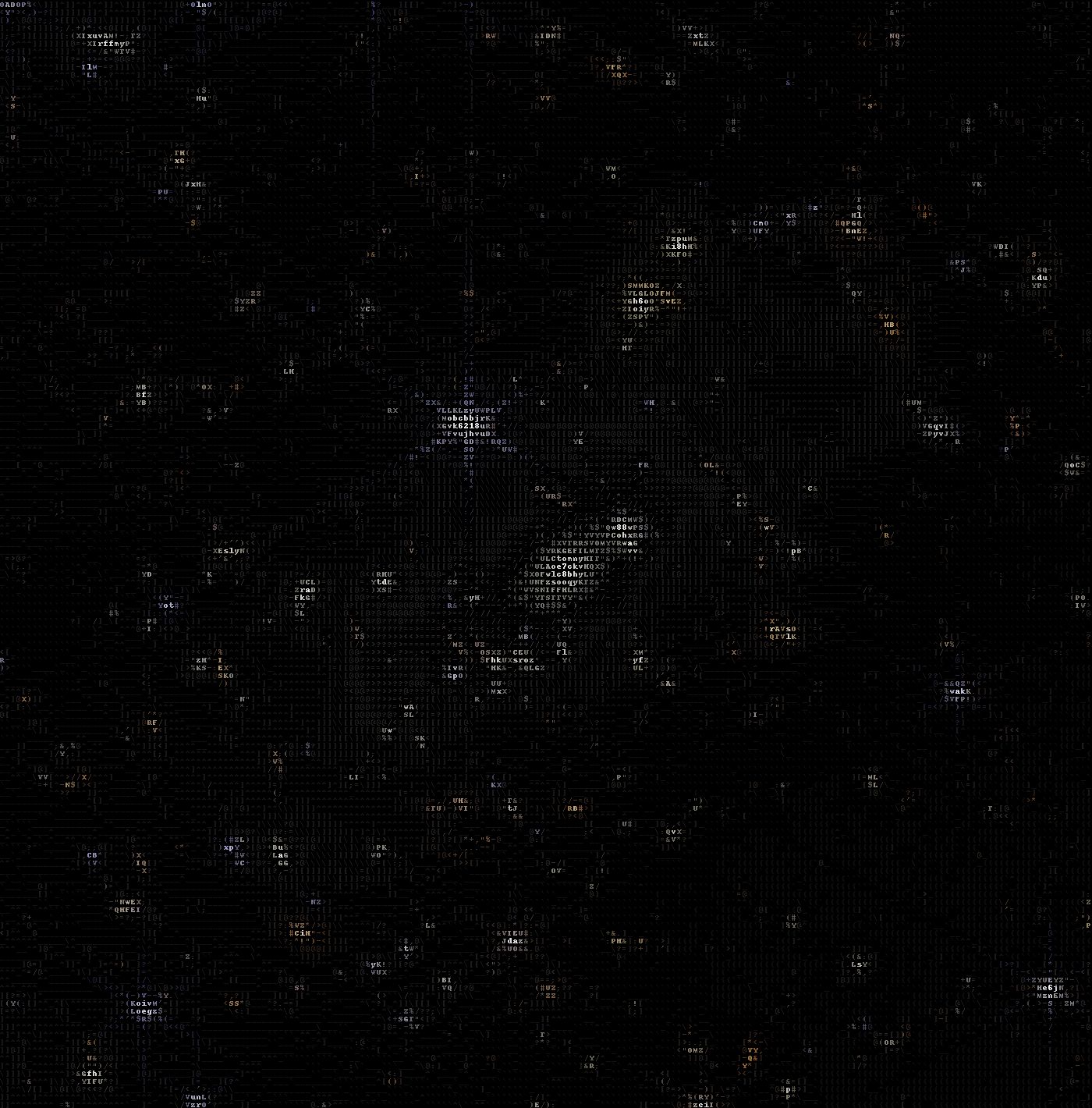
NASA’s James Webb Space Telescope has produced the deepest and sharpest infrared image of the distant universe to date. Known as Webb’s First Deep Field, this image of galaxy cluster SMACS 0723 is overflowing with detail.
Thousands of galaxies – including the faintest objects ever observed in the infrared – have appeared in Webb’s view for the first time. This slice of the vast universe is approximately the size of a grain of sand held at arm’s length by someone on the ground.
This deep field, taken by Webb’s Near-Infrared Camera (NIRCam), is a composite made from images at different wavelengths, totaling 12.5 hours – achieving depths at infrared wavelengths beyond the Hubble Space Telescope’s deepest fields, which took weeks.
The image shows the galaxy cluster SMACS 0723 as it appeared 4.6 billion years ago. The combined mass of this galaxy cluster acts as a gravitational lens , magnifying much more distant galaxies behind it. Webb’s NIRCam has brought those distant galaxies into sharp focus – they have tiny, faint structures that have never been seen before, including star clusters and diffuse features. Researchers will soon begin to learn more about the galaxies’ masses, ages, histories, and compositions, as Webb seeks the earliest galaxies in the universe.
This image is among the telescope’s first-full color images. The full suite will be released Tuesday, July 12, beginning at 10:30 a.m. EDT, during a live NASA TV broadcast. Learn more about how to watch .
The James Webb Space Telescope is the world's premier space science observatory. Webb will solve mysteries in our solar system, look beyond to distant worlds around other stars, and probe the mysterious structures and origins of our universe and our place in it. Webb is an international program led by NASA with its partners, ESA (European Space Agency) and CSA (Canadian Space Agency).
NASA Headquarters oversees the mission for the agency’s Science Mission Directorate. NASA’s Goddard Space Flight Center in Greenbelt, Maryland, manages Webb for the agency and oversees work on the mission performed by the Space Telescope Science Institute, Northrop Grumman, and other mission partners. In addition to Goddard, several NASA centers contributed to the project, including the agency’s Johnson Space Center in Houston, Jet Propulsion Laboratory (JPL) in Southern California, Marshall Space Flight Center in Huntsville, Alabama, Ames Research Center in California’s Silicon Valley, and others.
NIRCam was built by a team at the University of Arizona and Lockheed Martin’s Advanced Technology Center.
For a full array of Webb’s first images and spectra, including downloadable files, please visit: https://webbtelescope.org/news/first-images
This image shows many overlapping objects at various distances. They include foreground stars, galaxies in a galaxy cluster, and distorted background galaxies behind the galaxy cluster.
The background of space is black. Thousands of small galaxies appear across the image. Their colors vary. Some are shades of orange, others are white. Most appear as fuzzy ovals, but a few have distinctive spiral arms.
In front of the galaxies are several foreground stars. Most appear blue with diffraction spikes, forming eight-pointed star shapes. Some look as large as the galaxies that appear next to them.
A very bright star is slightly off center. It has eight blue, long diffraction spikes. In the center of the image, between 4 o’clock and 6 o’clock in the bright star’s spikes, are several bright, white galaxies. These are members of the galaxy cluster.
There are also many thin, long, orange arcs. They follow invisible concentric circles that curve around the center of the image. These are images of background galaxies that have been stretched and distorted by the foreground galaxy cluster.
Image showing thousands of distant galaxies of different shapes, sizes, colors, and brightness, with a scattering of bright foreground stars.
This image was created with Webb data from proposal 2736 . It is part of Webb Early Release Observations.
The Early Release Observations and associated materials were developed, executed, and compiled by the ERO production team:
Jaclyn Barrientes, Claire Blome, Hannah Braun, Matthew Brown, Margaret Carruthers, Dan Coe, Joseph DePasquale, Nestor Espinoza, Macarena Garcia Marin, Karl Gordon, Alaina Henry, Leah Hustak, Andi James, Ann Jenkins, Anton Koekemoer, Stephanie LaMassa, David Law, Alexandra Lockwood, Amaya Moro-Martin, Susan Mullally, Alyssa Pagan, Dani Player, Klaus Pontoppidan, Charles Proffitt, Christine Pulliam, Leah Ramsay, Swara Ravindranath, Neill Reid, Massimo Robberto, Elena Sabbi, Leonardo Ubeda.
The EROs were also made possible by the foundational efforts and support from the JWST instruments, STScI planning and scheduling, Data Management teams, and Office of Public Outreach.