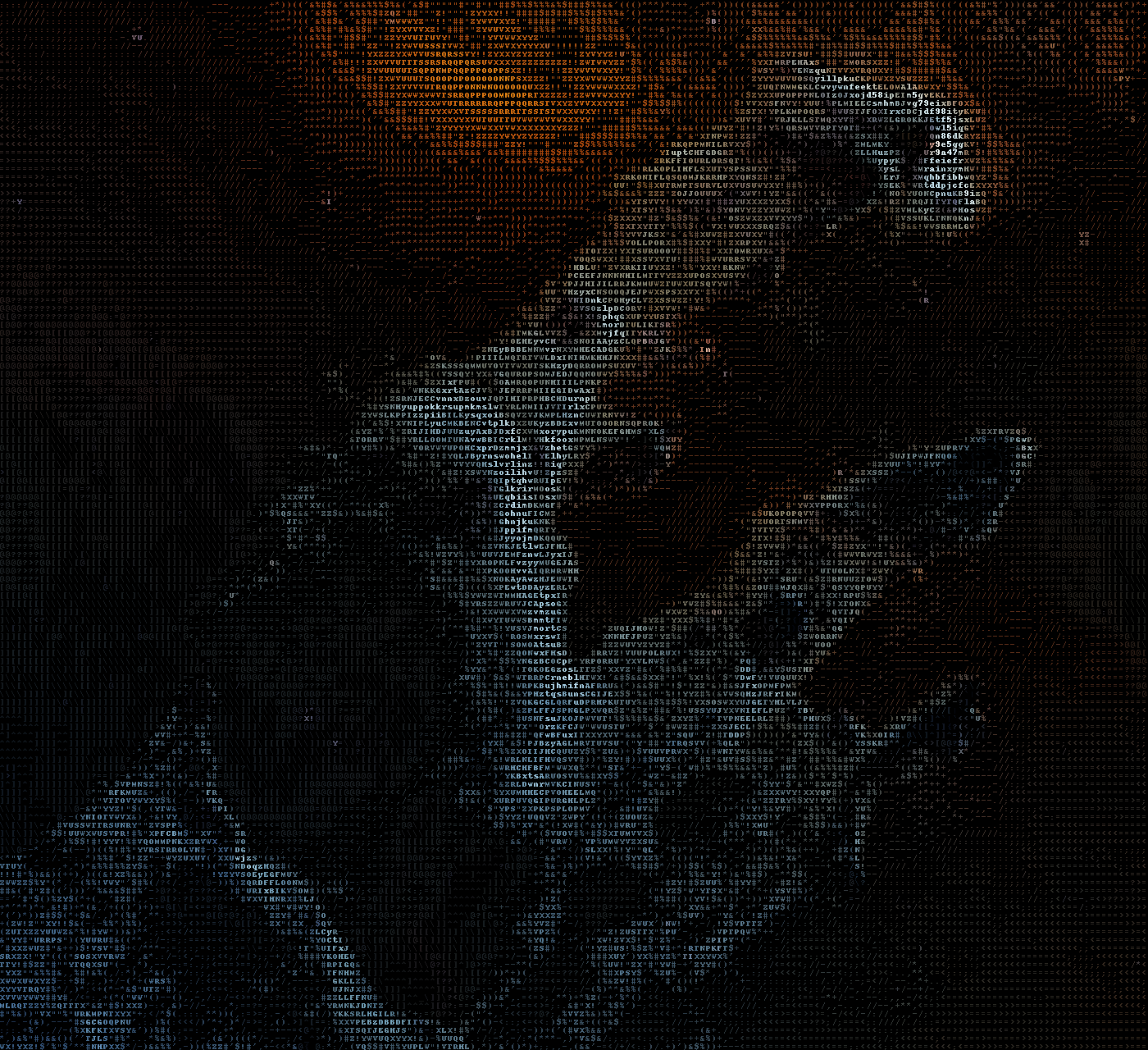
NASA’s James Webb Space Telescope’s mid-infrared view of the Pillars of Creation strikes a chilling tone. Thousands of stars that exist in this region disappear – and seemingly endless layers of gas and dust become the centerpiece.
The detection of dust by Webb’s Mid-Infrared Instrument (MIRI) is extremely important – dust is a major ingredient for star formation. Many stars are actively forming in these dense blue-gray pillars. When knots of gas and dust with sufficient mass form in these regions, they begin to collapse under their own gravitational attraction, slowly heat up – and eventually form new stars.
Although the stars appear missing, they aren’t. Stars typically do not emit much mid-infrared light. Instead, they are easiest to detect in ultraviolet, visible, and near-infrared light. In this MIRI view, two types of stars can be identified. The stars at the end of the thick, dusty pillars have recently eroded the material surrounding them. They show up in red because their atmospheres are still enshrouded in cloaks of dust. In contrast, blue tones indicate stars that are older and have shed most of their gas and dust.
Mid-infrared light also details dense regions of gas and dust. The red region toward the top, which forms a delicate V shape, is where the dust is both diffuse and cooler. And although it may seem like the scene clears toward the bottom left of this view, the darkest gray areas are where densest and coolest regions of dust lie. Notice that there are many fewer stars and no background galaxies popping into view.
Webb’s mid-infrared data will help researchers determine exactly how much dust is in this region – and what it’s made of. These details will make models of the Pillars of Creation far more precise. Over time, we will begin to more clearly understand how stars form and burst out of these dusty clouds over millions of years.
Contrast this view with Webb’s near-infrared light image .
MIRI was contributed by ESA and NASA, with the instrument designed and built by a consortium of nationally funded European Institutes (the MIRI European Consortium) in partnership with JPL and the University of Arizona.
At the bottom left are the thickest regions of gas and dust, which appear light blue and dark gray-blue. There are many layers of semi-opaque gas and dust overlaying one another. The first pillar points to the top right of the image. There is one prominent red star, with tiny spikes at its tip. Lower on this pillar, which forms a diagonal from bottom left to top right, there are several darker areas of dust that jut out, many with bright red stars, which appear as small red dots. Below the top pillar are two slightly smaller pillars, both ending in dark gray-blue regions. The second pillar has a dark arch that looks like an upside-down L halfway down. The third pillar is set off in dark blue and gray shades. At the bottom left is another overlapping area of gas and dust that forms a peak, but is also colored in various shades of gray and light blue. The background of this scene is washed in shades of deep red and light red. Toward the top center, a V shape appears above the top-most pillar. At its lowest point, it is brilliant red. There are only several dozen tiny bright white and blue stars. Larger stars appear redder and are embedded in the pillars.
Semi-opaque layers of blue and gray gas and dust start at the bottom left and rise toward the top right. There are three prominent pillars. The left pillar is the largest and widest. The peaks of the second and third pillars are set off in darker shades of blue outlines. Few red stars appear within the pillars. Some blue and white stars dot the overall scene.
This image was created from JWST data from proposal: 2739 (K. Pontoppidan)