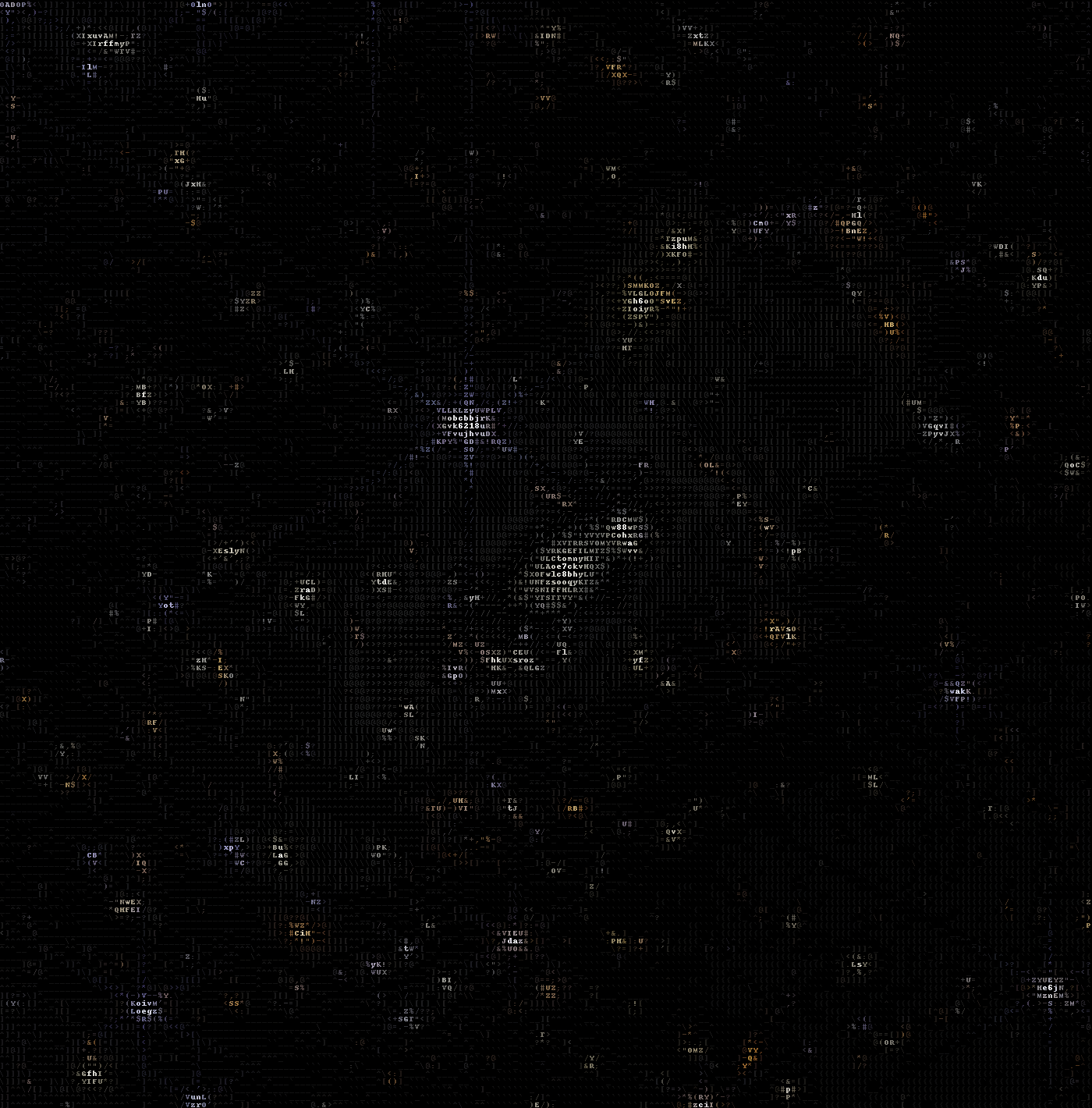
Thousands of galaxies flood this near-infrared image of galaxy cluster SMACS 0723. High-resolution imaging from NASA’s James Webb Space Telescope combined with a natural effect known as gravitational lensing made this finely detailed image possible.
First, focus on the galaxies responsible for the lensing: the bright white elliptical galaxy at the center of the image and smaller white galaxies throughout the image. Bound together by gravity in a galaxy cluster, they are bending the light from galaxies that appear in the vast distances behind them. The combined mass of the galaxies and dark matter act as a cosmic telescope, creating magnified, contorted, and sometimes mirrored images of individual galaxies.
Clear examples of mirroring are found in the prominent orange arcs to the left and right of the brightest cluster galaxy. These are lensed galaxies – each individual galaxy is shown twice in one arc. Webb’s image has fully revealed their bright cores, which are filled with stars, along with orange star clusters along their edges.
Not all galaxies in this field are mirrored – some are stretched. Others appear scattered by interactions with other galaxies, leaving trails of stars behind them.
Webb has refined the level of detail we can observe throughout this field. Very diffuse galaxies appear like collections of loosely bound dandelion seeds aloft in a breeze. Individual “pods” of star formation practically bloom within some of the most distant galaxies – the clearest, most detailed views of star clusters in the early universe so far.
One galaxy speckled with star clusters appears near the bottom end of the bright central star’s vertical diffraction spike – just to the right of a long orange arc. The long, thin ladybug-like galaxy is flecked with pockets of star formation. Draw a line between its “wings” to roughly match up its star clusters, mirrored top to bottom. Because this galaxy is so magnified and its individual star clusters are so crisp, researchers will be able to study it in exquisite detail, which wasn’t previously possible for galaxies this distant.
The galaxies in this scene that are farthest away – the tiniest galaxies that are located well behind the cluster – look nothing like the spiral and elliptical galaxies observed in the local universe. They are much clumpier and more irregular. Webb’s highly detailed image may help researchers measure the ages and masses of star clusters within these distant galaxies. This might lead to more accurate models of galaxies that existed at cosmic “spring,” when galaxies were sprouting tiny “buds” of new growth, actively interacting and merging, and had yet to develop into larger spirals. Ultimately, Webb’s upcoming observations will help astronomers better understand how galaxies form and grow in the early universe.
NIRCam was built by a team at the University of Arizona and Lockheed Martin’s Advanced Technology Center.
For a full array of Webb’s first images and spectra, including downloadable files, please visit: https://webbtelescope.org/news/first-images
This image shows many overlapping objects at various distances. They include foreground stars, galaxies in a galaxy cluster, and distorted background galaxies behind the galaxy cluster.
The background of space is black. Thousands of small galaxies appear across the image. Their colors vary. Some are shades of orange, others are white. Most appear as fuzzy ovals, but a few have distinctive spiral arms.
In front of the galaxies are several foreground stars. Most appear blue with diffraction spikes, forming eight-pointed star shapes. Some look as large as the galaxies that appear next to them.
A very bright star is slightly off center. It has eight blue, long diffraction spikes. In the center of the image, between 4 o’clock and 6 o’clock in the bright star’s spikes, are several bright, white galaxies. These are members of the galaxy cluster.
There are also many thin, long, orange arcs. They follow invisible concentric circles that curve around the center of the image. These are images of background galaxies that have been stretched and distorted by the foreground galaxy cluster.
Image showing thousands of distant galaxies of different shapes, sizes, colors, and brightness, with a scattering of bright foreground stars.
This image was created with Webb data from proposal 2736 . It is part of Webb Early Release Observations.
The Early Release Observations and associated materials were developed, executed, and compiled by the ERO production team:
Jaclyn Barrientes, Claire Blome, Hannah Braun, Matthew Brown, Margaret Carruthers, Dan Coe, Joseph DePasquale, Nestor Espinoza, Macarena Garcia Marin, Karl Gordon, Alaina Henry, Leah Hustak, Andi James, Ann Jenkins, Anton Koekemoer, Stephanie LaMassa, David Law, Alexandra Lockwood, Amaya Moro-Martin, Susan Mullally, Alyssa Pagan, Dani Player, Klaus Pontoppidan, Charles Proffitt, Christine Pulliam, Leah Ramsay, Swara Ravindranath, Neill Reid, Massimo Robberto, Elena Sabbi, Leonardo Ubeda.
The EROs were also made possible by the foundational efforts and support from the JWST instruments, STScI planning and scheduling, Data Management teams, and Office of Public Outreach.