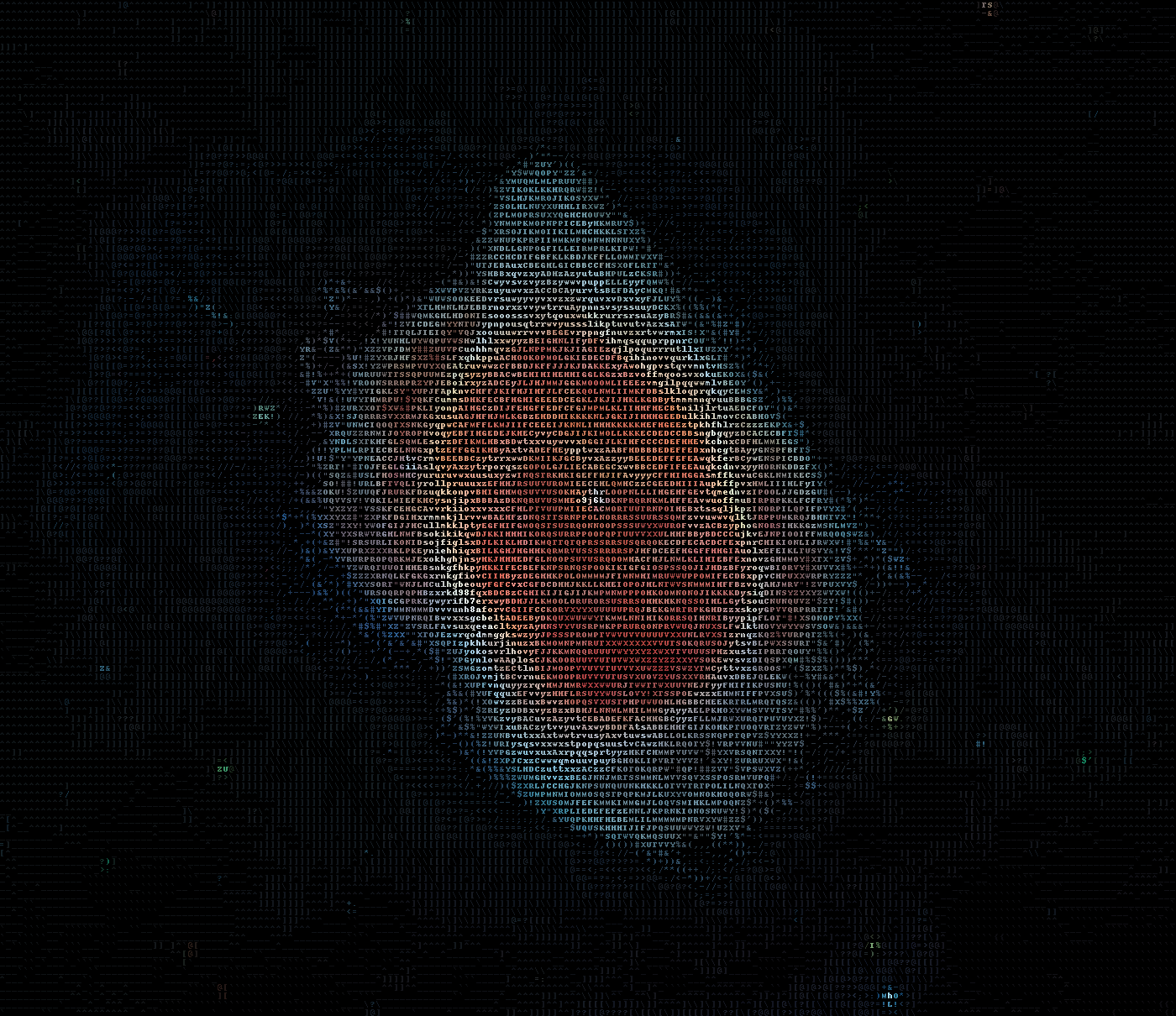
NASA’s Webb Telescope has revealed the cloak of dust around the second star, shown at left in red, at the center of the Southern Ring Nebula for the first time. It is a hot, dense white dwarf star .
As it transformed into a white dwarf, the star periodically ejected mass – the shells of material you see here. As if on repeat, it contracted, heated up – and then, unable to push out more material, pulsated.
At this stage, it should have shed its last layers. So why is the red star still cloaked in dust? Was material transferred from its companion? Researchers will begin to pursue answers soon.
The bluer star at right in this image has also shaped the scene. It helps stir up the ejected material. The disk around the stars is also wobbling, shooting out spirals of gas and dust over long periods of time. This scene is like witnessing a rotating sprinkler that’s finished shooting out material in all directions over thousands of years.
Webb captured this scene in mid-infrared light – most of which can only be observed from space. Mid-infrared light helps researchers detect objects enshrouded in dust, like the red star.
This Mid-Infrared Instrument (MIRI) image also offers an incredible amount of detail, including a cache of distant galaxies in the background. Most of the multi-colored points of light are galaxies, not stars. Tiny triangles mark the circular edges of stars, including a blue one within the nebula’s red bottom-most edges, while galaxies look like misshapen circles, straight lines, and spirals.
For a full array of Webb’s first images and spectra, including downloadable files, please visit: https://webbtelescope.org/news/first-images
MIRI was contributed by ESA and NASA, with the instrument designed and built by a consortium of nationally funded European Institutes (The MIRI European Consortium) in partnership with JPL and the University of Arizona.
This image was created with Webb data from proposal 2733 . It is part of Webb Early Release Observations.
The Early Release Observations and associated materials were developed, executed, and compiled by the ERO production team:
Jaclyn Barrientes, Claire Blome, Hannah Braun, Matthew Brown, Margaret Carruthers, Dan Coe, Joseph DePasquale, Nestor Espinoza, Macarena Garcia Marin, Karl Gordon, Alaina Henry, Leah Hustak, Andi James, Ann Jenkins, Anton Koekemoer, Stephanie LaMassa, David Law, Alexandra Lockwood, Amaya Moro-Martin, Susan Mullally, Alyssa Pagan, Dani Player, Klaus Pontoppidan, Charles Proffitt, Christine Pulliam, Leah Ramsay, Swara Ravindranath, Neill Reid, Massimo Robberto, Elena Sabbi, Leonardo Ubeda.
The EROs were also made possible by the foundational efforts and support from the JWST instruments, STScI planning and scheduling, Data Management teams, and Office of Public Outreach.