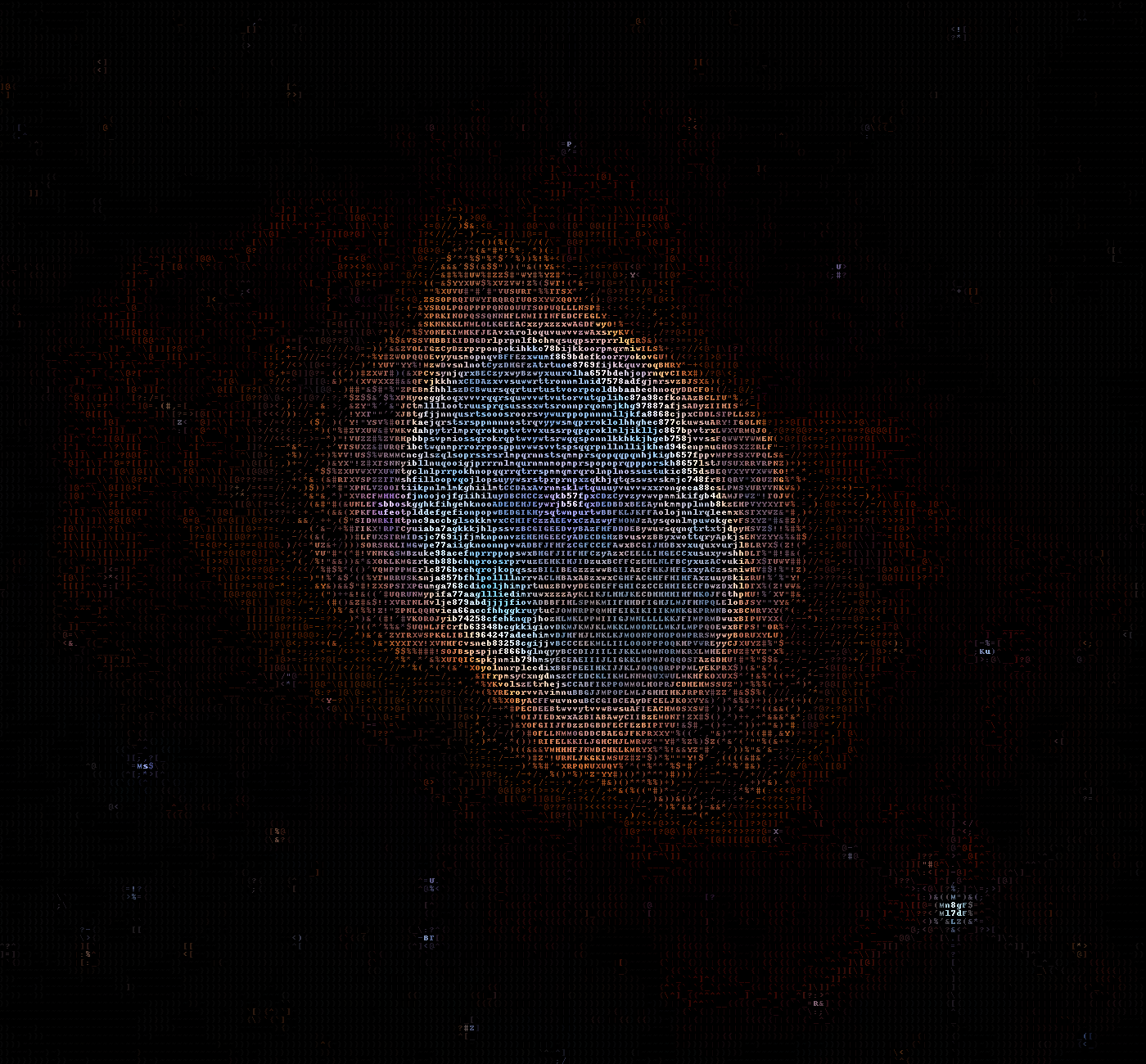
The bright star at the center of NGC 3132, while prominent when viewed by NASA’s Webb Telescope in near-infrared light, plays a supporting role in sculpting the surrounding nebula. A second star, barely visible at lower left along one of the bright star’s diffraction spikes, is the nebula’s source. It has ejected at least eight layers of gas and dust over thousands of years.
But the bright central star visible here has helped “stir” the pot, changing the shape of this planetary nebula’s highly intricate rings by creating turbulence. The pair of stars are locked in a tight orbit, which leads the dimmer star to spray ejected material in a range of directions as they orbit one another, resulting in these jagged rings.
Hundreds of straight, brightly-lit lines pierce through the rings of gas and dust. These “spotlights” emanate from the bright star and stream through holes in the nebula like sunlight through gaps in a cloud.
But not all of the starlight can escape. The density of the central region, set off in teal, is reflected by how transparent or opaque it is. Areas that are a deeper teal indicate that the gas and dust are denser – and light is unable to break free.
Data from Webb’s Near-Infrared Camera (NIRCam) were used to make this extremely detailed image. It is teeming with scientific information – and research will begin following its release.
This is not only a crisp image of a planetary nebula – it also shows us objects in the vast distances of space behind it. The transparent red sections of the planetary nebula – and all the areas outside it – are filled with distant galaxies.
Look for the bright angled line at the upper left. It is not starlight – it is a faraway galaxy seen edge-on. Distant spirals, of many shapes and colors, also dot the scene. Those that are farthest away – or very dusty – are small and red.
For a full array of Webb’s first images and spectra, including downloadable files, please visit: https://webbtelescope.org/news/first-images
NIRCam was built by a team at the University of Arizona and Lockheed Martin’s Advanced Technology Center.
This image was created with Webb data from proposal 2733 . It is part of Webb Early Release Observations.
The Early Release Observations and associated materials were developed, executed, and compiled by the ERO production team:
Jaclyn Barrientes, Claire Blome, Hannah Braun, Matthew Brown, Margaret Carruthers, Dan Coe, Joseph DePasquale, Nestor Espinoza, Macarena Garcia Marin, Karl Gordon, Alaina Henry, Leah Hustak, Andi James, Ann Jenkins, Anton Koekemoer, Stephanie LaMassa, David Law, Alexandra Lockwood, Amaya Moro-Martin, Susan Mullally, Alyssa Pagan, Dani Player, Klaus Pontoppidan, Charles Proffitt, Christine Pulliam, Leah Ramsay, Swara Ravindranath, Neill Reid, Massimo Robberto, Elena Sabbi, Leonardo Ubeda.
The EROs were also made possible by the foundational efforts and support from the JWST instruments, STScI planning and scheduling, Data Management teams, and Office of Public Outreach.